A missing tooth does not fix itself. Waiting rarely makes the decision easier, and the gap can affect your bite over time. The three main replacement options work in very different ways, and each one fits a different budget, timeline, and mouth.
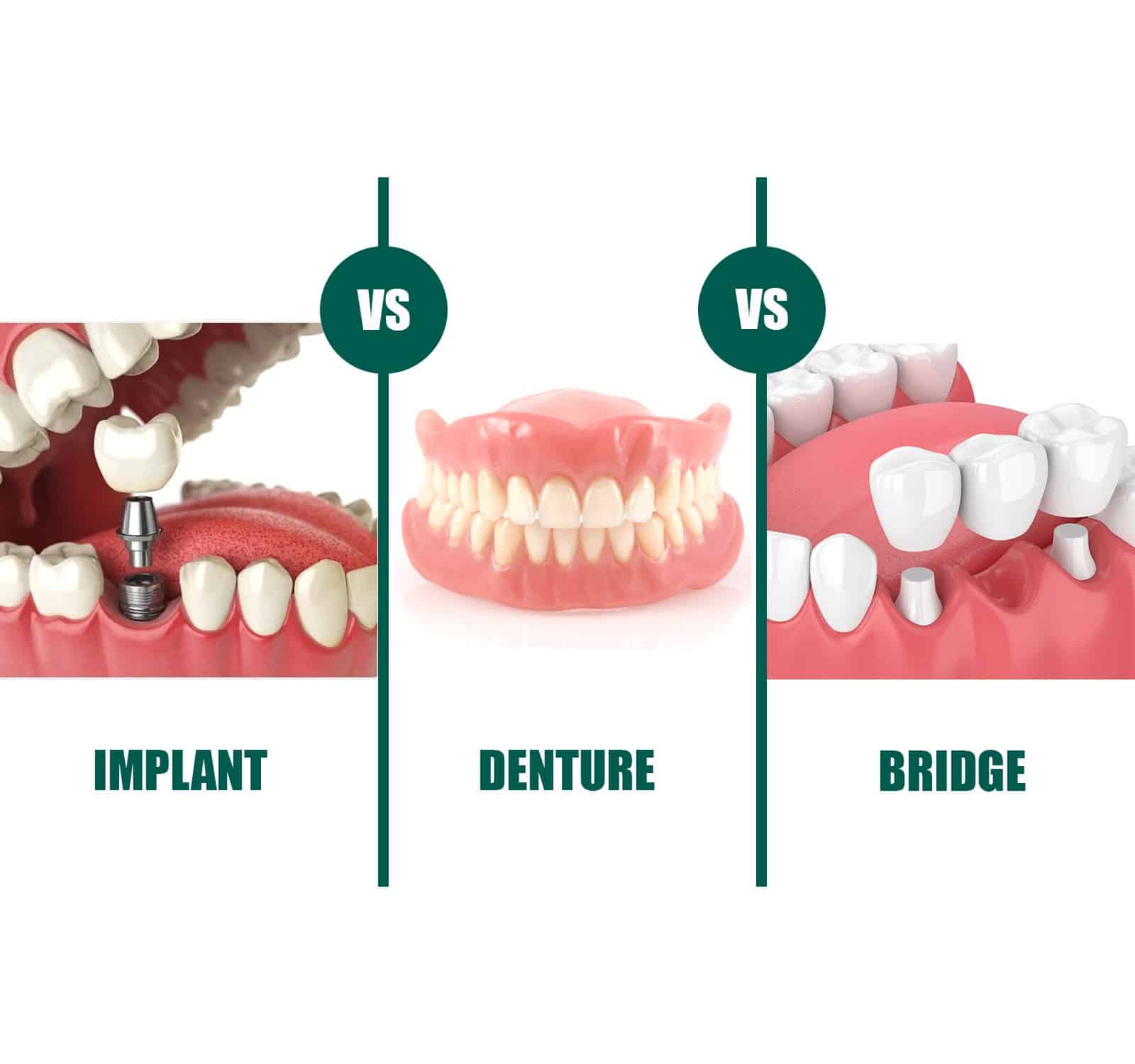
An implant replaces the tooth root with a titanium post, then adds a crown on top. A bridge anchors a replacement tooth to the two healthy teeth beside the gap. A partial denture clips onto your remaining teeth and comes out at night. Dental implants at Meadowleaf Dental start with a full consultation, since cost, timeline, and jaw health differ across all three options.
Dr. Rahim Ali, DDS, focuses much of his restorative work at Meadowleaf Dental on implant-retained crowns and bridges. He walks patients through this exact decision at almost every consultation. He says the choice usually comes down to budget, timeline, and how the neighbouring teeth look on an X-ray.
What to know before you choose a replacement option
- An implant costs the most upfront, but it is the only option that stops jawbone loss under the gap.
- A bridge reshapes the two healthy teeth next to the gap, and it typically lasts 5 to 15 years.
- A partial denture costs the least and needs no surgery, but it comes out for cleaning every day.
- CDCP does not cover dental implants unless one is medically necessary, so most implant patients pay out of pocket.
- A short consultation can usually tell you which option fits your mouth and your budget.
Your three options for replacing one missing tooth
An implant is a titanium post placed in the jawbone. A crown goes on top once the post fuses to the bone. Meadowleaf Dental reviews your oral history, the missing-tooth area, and your jaw and gum health before recommending this route. That fusion step is why an implant takes longer than the other two options.
A bridge skips the jawbone step entirely. It anchors an artificial tooth to the two teeth on either side of the gap. The dentist reshapes and crowns those two healthy teeth to hold the bridge in place, which permanently removes some of their natural structure. Meadowleaf Dental publishes a real number for this option: a dental bridge, priced between $1,500 and $5,000 per tooth, depending on the materials used, and lasting 5 to 15 years or more.
A partial denture works differently again. It clips onto your remaining natural teeth and comes out for cleaning. Meadowleaf Dental builds a partial denture from a digital scan, then fits and adjusts it over a couple of visits. Some patients find a denture takes a few weeks to feel normal in the mouth.
Each option asks something different of you. An implant needs enough healthy bone. A bridge needs two healthy teeth willing to carry extra load. A denture just needs you to remove and clean it every day, and to keep track of it.
Implant vs. bridge vs. denture, side by side
| Dental implant | Dental bridge | Partial denture | |
| Surgery required | Yes | No | No |
| Affects neighbouring teeth | No | Yes, they are reshaped | No |
| Typical lifespan | Can last a lifetime with care | 5 to 15 years | 7 to 15 years on average |
| Stops jawbone loss | Yes | No | No |
| Upfront cost | Highest | Mid-range | Lowest |
A bridge is often ready within a few weeks. A partial denture takes a couple of visits after the scan. An implant can take several months from placement to final crown, since the bone needs time to fuse around the post. None of the three happens in a single appointment, so plan around that timeline before you commit. A quick chat at your consultation can set the right expectations early.
How much does each option actually cost?
Implants generally cost more upfront than a bridge or a denture. Meadowleaf Dental does not quote an implant price without a consultation, since bone grafting and other factors change the total. A bridge sits in the middle at $1,500 to $5,000 per tooth. A partial denture usually costs the least of the three, though the exact fee still depends on your case and how many teeth it needs to replace.
Cost rarely stands alone, though. Most patients weighing one missing tooth are also thinking about something else. Maybe a crown, a filling, or some gum work elsewhere in the mouth. A separate post on how restorative dentistry rebuilds more than just your smile covers this bigger financial picture in more depth, beyond just one missing tooth. It is worth a read if you are weighing several restorative needs at once, not just a single gap.
CDCP does not cover dental implants unless one is medically necessary. That exclusion catches a lot of patients off guard partway through planning treatment. Ask directly whether your case might qualify before you commit to a plan, since the answer changes your real out-of-pocket cost.
Are you a candidate for a dental implant?
Bone and gum health decide this first. An implant needs enough healthy bone to hold the post. A jaw that has lost bone density after years without a tooth may need grafting first. In some cases, it may not be a candidate at all. Smokers, patients with uncontrolled diabetes, and patients with active gum disease are generally not ideal implant candidates. That changes once they bring those issues under control.
A bridge or denture can work well for patients who are not implant candidates yet. Neither one asks anything of the jawbone the way an implant does. Meadowleaf Dental checks your bone and gum health at a consultation, rather than assuming from your age or history alone. Age by itself rules nobody out. A healthy 70-year-old can be a better implant candidate than a 40-year-old with advanced gum disease.
Which option is actually right for you?
Start with your dental health, not your budget. If you are not a good implant candidate right now, a bridge or denture may be the only realistic option regardless of cost. If you are a candidate for all three, the decision usually comes down to timeline and how much jawbone preservation matters to you.
A bridge or denture gets you a functional bite faster and for less money upfront. An implant costs more and takes longer. Nothing else stops the bone loss that continues under a gap left unfilled for years. Neither choice is wrong. They simply solve different problems. A good consultation should name which problem matters most for your mouth before it names a price.
Choosing a tooth-replacement option at Meadowleaf Dental in Edmonton
The fastest way to know which option fits is a consultation, not a guess from general information online. Meadowleaf Dental sees patients across southeast Edmonton, including The Meadows, Tamarack, and Wild Rose. Every consultation reviews your specific bone, gum, and bite situation before recommending anything. Checking whether CDCP covers any of this is worth asking at the same visit.
Dr. Ali’s focus on implant-retained crowns and bridges means the same dentist who evaluates your case can also place the restoration. That continuity matters for a decision this personal, and it means fewer handoffs between different providers.
Ready to find out which option fits your mouth? Call Meadowleaf Dental at (780) 485-2911 or book online. Dr. Ali will walk you through your options at your consultation.